| Store > Heat Exchangers | ||||||||||||||||||||||||||||||||||||||||||||||||||||||||||||||||||||||||||||||||||||||||||||||||||||||||||||||||||||||||||||||||||||||||||||||||||||||||||||||||||||||||||||||
We carry many different sized copper brazed plate heat exchangers, with various welded-in fitting options & varying number of plates. These units may be used for SVO conversions, beer wort chilling, biodiesel cooling or heating, refrigeration & boiler applications. Stainless Steel Copper Brazed Plate Heat ExchangersHow Heat Transfer WorksHeat transfer occurs when there is a difference in temperature between two mediums. Heat will travel from the hot source to the cold source. The rate at which the heat transfer occurs at is determined by many factors such as the heat conductivity of the two materials andthe difference in temperatures of the two mediums. Convectiuve heat transfer occurs when the materials are moving against each other. Plate heat exchangers have significantly good heat transfer rates because they use metal plates which have high heat conductivity rates and the plates are extremely thin. The plate heat exchangers also achieve high amounts of heat transfer through convective forces with both working fluids. With large temperature differentials, great amounts of heat transfer can be achieved using a plate heat exchanger. CorrosionCorrosion is usually how these units will fail. Use fluids with reasonable pH levels to ensure a long lasting life. Hard water will corrode faster than regular water. (Use distilled if possible; Distilled should never corrode it) Salt water will corrode stainless steel very fast. It is recommended to clean the exchanger often if you are using corrosive fluids. Normal usage (non-corrosive fluids) should expect 10-20 years of life. Fluids containing chlorides will corrode the unit quickly. ApplicationsThis is an extremely popular unit for wood burning furnaces, radiant floor systems, refrigerant systems, straight vegetable oil conversions, beer chilling, air conditioning system and solar water heating systems. It will work for any application in which the desired result is for two fluids (liquid or gas) to exchange heat.
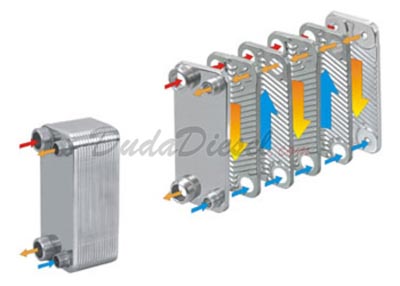
This image shows a counter flow configuration. Counter flow is the most efficient configuration since in theory, the cold fluid can reach the same temperature as the hot fluid. How it WorksFluid A passes from the port on the left of the heat exchanger through every other channel created by the plates to the opposite end port on the left of the heat exchanger (looking at it the long way). Fluid B passes from the port on the right through the other channels created by the plates and comes out the other port on the right side. The fluids are essentially touching each other through the plates and heat is transferred from the hot fluid to the cold fluid. (but the fluids do not mix) PerformanceBeer Wort Chilling - Please see the following charts for performance estimates on applications specific to beer wort chilling. Beer wort chilling chart (pdf) What Size & How Many Plates?
Generally speaking, the more length the heat exchanger has, the more efficiency in heat transfer it has. An infinitely long heat exchanger would allow for the hot fluid to become the temperature of the cold fluid and the cold fluid the hot fluid, assuming perfect energy balance. The more plates and more width the heat exchanger has, the less pressure loss to the fluids flowing through. While adding more plates and width may increase some heat transfer, it is best to add more length for optimal heat transfer gain. More plates and width should be considered when flow rates reach half or more the max flow rate for the particular unit to avoid pressure loss in the fluid flow. Pressure loss means a slower flowing liquid and therefore, less heat transfer overall. In our designs, we typically allow up to a 7.5 psi pressure drop, which is generally accepted as non-interfering with flow rates in a heat transfer application. Most low flow applications experience less than 1 psi drop.
Heat Exchanger SizingNeed a heat exchanger sized for you? Please tell us your email address, fluid media/substance (if using antifreeze, we need to know how much %water and %ethlyene glycol or propylene glycol you have), and 1 of the other 3 variables for the hot/cold fluid parameters. We will size the best heat exchanger for your application based on the given parameters and estimate the result of the other 2 parameters left blank based on that heat exchanger's performance. Please do not provide ranges of numbers. If you are not sure what a parameter will be, give the worst case scenario.
CertificationsThe following are certifications/testings which apply to all of our heat exchangers:
|
||||||||||||||||||||||||||||||||||||||||||||||||||||||||||||||||||||||||||||||||||||||||||||||||||||||||||||||||||||||||||||||||||||||||||||||||||||||||||||||||||||||||||||||
|
|
||||||||||||||||||||||||||||||||||||||||||||||||||||||||||||||||||||||||||||||||||||||||||||||||||||||||||||||||||||||||||||||||||||||||||||||||||||||||||||||||||||||||||||||
|
Home | Customer Login | View Cart | Check Out | Forums | Contact Us | Affiliate Program
Heat Exchangers | Pumps | Filters | All Chemicals | Fluoroelastomer Hose (Like Viton Hose) Other Chemicals | Solenoid Valves | Stainless Steel Fittings | Stainless Steel Ball Valves | Check Valves Cone Tanks | Solar Water Heaters | Propane Conversion Kits | LED Lighting Magnetic Stirrers |
||||||||||||||||||||||||||||||||||||||||||||||||||||||||||||||||||||||||||||||||||||||||||||||||||||||||||||||||||||||||||||||||||||||||||||||||||||||||||||||||||||||||||||||