Industrial Filter Bags
Use for Filtering Any Liquid!
by Duda Energy
Information on Different Types of Filter bags
General Introduction to Liquid Filtration
All filtration and screening involves limiting the passage of various sized solids by means of a barrier or fabric or media. This is done in two ways, by depth filtration using graded density material called felt or by surface filtration using filament woven material called mesh. Wovens, in turn have two basic varieties: multifilament and monofilament. In any application, variables such as flow volume, solids loading, shape and density of contaminants and other factors make this an inexact science. A general description of separation methods of media is helpful.
FELT
This is a filtration media made from a matrix of small fibers. One side is heat bonded to provide a uniform surface free of fiber loss. Contaminant particles are contained within the media by inpingment and entrapment. "Porosity" is defined by nominal micron ratings (1, 5,10,25,50,100,200) indicating the largest particle that can pass through, in general, and reflecting an increase in the density.
|
FELT |
|
ADVANTAGES |
DISADVANTAGES |
|
High Flow Rate |
Cannot be cleaned |
|
Low Cost |
Inexact filtration |
|
Easy disposal of solids in bag |
Variable performance |
|
High solids capacity |
|
PTFE MEMBRANE SURFACE FELT
This is a filter media having a "Teflon" microporous membrane applied to a base of polyester felt. This results in a nonstick surface which allows for a contaminant "cake" to build and slough off or be removed by cleaning.
|
PTFE Coated Felt |
|
ADVANTAGES |
DISADVANTAGES |
|
Consistent filtration |
High cost |
|
Extended life |
Lower flow rate |
|
Sub-micron potential |
Low solids capacity |
PEMU - MULTIFILAMENT MESH FABRIC (POLYESTER)
This is a two-dimensional square-woven fabric used for light filtration and general purpose screening. Consistently woven using a given number of threads per inch, its filaments are comprised of small fibers, twisted into threads. It is generally made of polyester polymer. "Porosity" is defined in broad divisions of hole size, measured in microns (i.e. 100, 150, 250, 400, 600, 800)
|
PEMU (Polyester) |
|
ADVANTAGES |
DISADVANTAGES |
|
Low Cost |
Moderate accuracy |
|
Disposable |
low solids capacity |
|
Can be used to prescreen |
not as strong as NMO |
|
Moderately Cleanable |
blinding of hole |
NMO - MONOFILAMENT MESH (NYLON)
A two-dimensional square of woven mesh fabric used for lower solids or higher accuracy screening and classification of solids. Made from a smooth uniform, one piece extruded thread woven into a screen with high accuracy and consistency. Used for exact separation. "Porosity" is defined by a hole size in microns, with greater variety than multifilaments (i.e. 25, 50, 75, 100, 120, 150, 175, 200, 250, 300, 400, 500, 600, 800).
|
NMO (Nylon) |
|
ADVANTAGES |
DISADVANTAGES |
|
Strong |
Blinding |
|
Very cleanable |
High Cost |
|
Accurate |
Low solid capacity |
| Chemical Resistivities and Temperature Ratings |
| Medias |
Mineral Acids |
Organic Acids |
Alkalis |
Oxidizing Acids |
Animal Vegetable Petro-Oils |
Organic Solvents |
Micro Organisms |
Working Fluid Temp Limits (°F) |
|
Polyester |
Good |
Good |
Good |
Good |
Excellent |
Excellent |
Excellent |
275° |
|
Polypropylene |
Good |
Excellent |
Good |
Fair |
Excellent |
Good |
Excellent |
200° |
|
Nylon |
Poor |
Fair |
Good |
Poor |
Excellent |
Excellent |
Excellent |
300° |
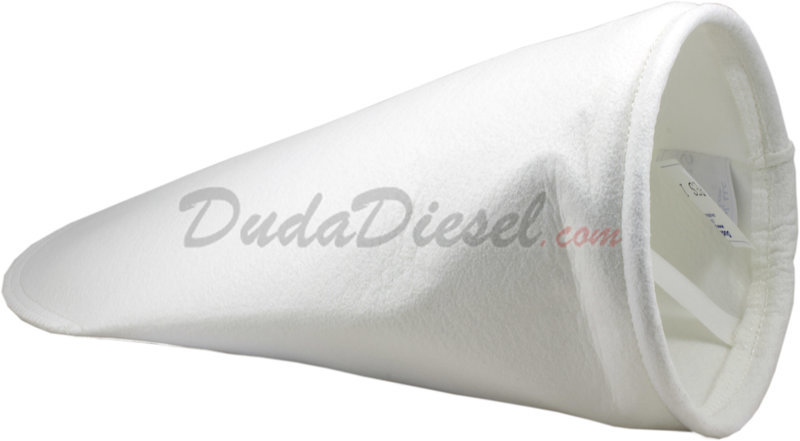 POG P1S Polypropylene Filter Bag 7" x 16" size #1
 POG P1S Polypropylene Filter Bag 7" x 16" size #1
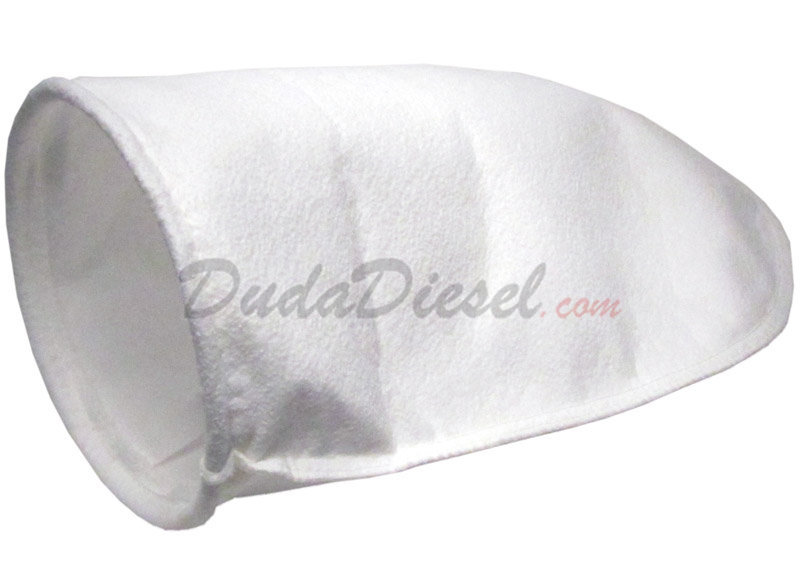 Polypropylene 16" Filter Bag
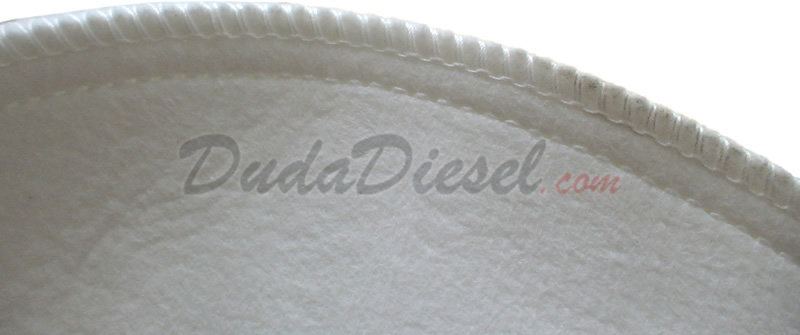 Quality Sewing Polypropylene Filter Bag